Adam slipped one past council
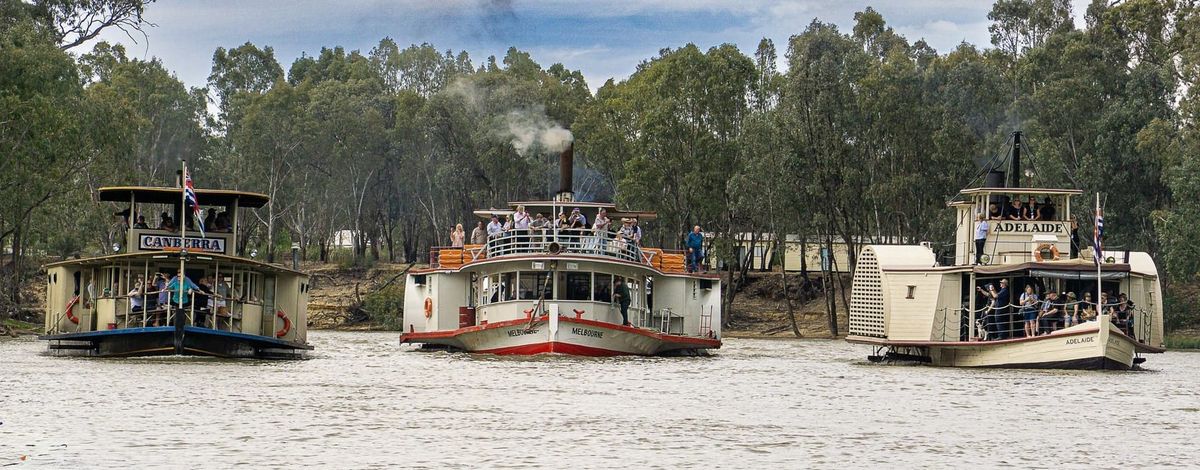
Adam Auditori is essential to the smooth running – and sailing – of the Murray River’s paddle steamer fleet.
Not to mention the hundreds of houseboats which ply the waters between Mildura and the Barmah Forest.
Because he is the keeper of the Moama slipway and if he wasn’t here with the nuts and bolts of the business, your next maintenance port of call is 700 downstream kilometres away, almost to the South Australian border.
Adam also owns and operates the PS Melbourne, which he bought in Mildura in 2024 and sailed into Echuca in November last year – the first time the Melbourne had been back since 1965.
Bringing his story full circle – he first fell in love with the river life as a 14-year-old camping in the Pianta Forest and watching the Emmylou float by on a weekly basis.
Enchanted by river lore he wrote to the then City of Echuca council to be a volunteer worker on the paddle steamers.
“I might have forgotten to tell them I was only 14 when I wrote, because when I turned up their mouths dropped open,” Adam laughs.
“They told me they didn’t have junior insurance so couldn’t use me – but I kept going back, kept turning up each weekend and holidays generally being a pain in their collective arses,” he admits. The council then gained cover for a junior volunteer.
After a couple of weeks as a deckhand on Pevensey it led to the one thing which had never crossed my young mind at the time – steam engines.
“Neil Cook asked me to help him fire the boiler one day and I was hooked and have never been able to let it go.”
The boiler and its operation took Adam down the mechanical path, and he was taken under the wing of the legendary river shipwright Kevin Hutchinson.
When he turned 17 the Port Authority advertised internally for an apprentice shipwright, he applied and a life’s journey became set in history and steam.
Even though a formal apprenticeship brought an end to Adam’s Huckleberry Finn like days of roaming the riverbanks and hanging out with old blokes on paddle steamers and condemned him to four years of studies to be a boat builder and shipwright at Victoria University despite having held a captain’s and engineer’s ticket since he was 18.
Adam says there were 14 students in his course with careers as diverse as working on the fibreglass shells for Victoria’s train building industry at Castlemaine to one from a wooden boat shop in Sorrento.
Today even the course, like so many of the skills honed through it, is gone.
And shipwrights are becoming almost as scarce.
But back then, the newly graduated Adam began what has been an endless series of projects and restorations up and down the Murray. He worked on the Pevensey, the Adelaide and the resurrection and restoration of the Alexander Arbuthnot. He helped put the red gum hull back on the Hero (she was built in 1874) for the Byford family and had a big hand in saving the old steam tug Hebe based out of Waikerie/Ramco in South Australia.
“The Hebe is a great story, she worked for CSR in the sugar industry on the Clarence River at Grafton, and they sailed it all the way around the coast to SA, up into the Murray at Goolwa and on to Ramco,” Adam explains.
“That one took a while, so it was three weeks in SA and two back home in Victoria – we worked on her from 2001 until well into the next year.
“Then there was the Oscar W – she was built in Echuca in 1908 but left here in 1964. She came back in 1991 and visited again in the early 2000s – we had to get her into commercial survey, similar to the work we did on the Pevensey. Today she works out of Goolwa in SA,” he says.
Adam worked on the PS Canally at Morgan in SA – that was a complete hull rebuild – and did car ferries for the SA government and maintained SA Water’s maintenance fleet of old timber barges.
If there was a paddle steamer, or very near cousin – afloat or submerged – Adam was the go-to guy to get them going again.
In 2021 he was behind a major rebuild of the Pevensey during Covid and in February of the same year took over the slipway from Rob Symons (who owns the PS Etona, launched in 1898 by the Anglican Diocese of Adelaide as a mission boat).
“I really got stuck in there, rebuilt the foundations, upgraded the facility and got all the rigging, winch and cables improved and recertified to 150 tonnes – as a guide the Pevensey is 140 tonnes,” Adam says.
“The Melbourne is 130 tonnes, can carry 297 passengers and is 1m wider than the Pevensey but 3m shorter,” he adds.
While he waits to get a permanent berth in the port, Adam sails the Melbourne out of the Moama wharf and like most owners, spends time worrying about where the next load of red gum will come from for hull repairs.
Some of the wood he is using comes from as far afield as Queensland.
If you wonder how much wood a wooden boat would need, well on a good day there’s about $150,000 worth in the hull – and even the bits not below water suffer badly from sun and water glare along with rot.
Maintaining them is like painting the Sydney Harbor bridge – as soon as you get to the end you need to start all over at the other end.